
Lederudvikling
Choosing to grow: The leader’s blueprint
Driving sustainable, inclusive growth requires the right mindset, strategy, and capabilities. Here are some steps that could help foster successful growth.
This article is a collaborative effort by Michael Birshan, Biljana Cvetanovski, Rebecca Doherty, Tjark Freundt, Andre
Gaeta, Greg Kelly, Erik Roth, Ishaan Seth, and Jill Zucker, representing views from McKinsey’s Growth, Marketing &
Sales and Strategy & Corporate Finance practices.
Læs og download artiklen via dette link: Choosing-to-grow-the-leaders-blueprint. Kilde McKinsey 2022

Growth is something every CEO and business leader aspires to deliver, but for many, it remains elusive. About a quarter of companies don’t grow at all, and between 2010 and 2019, only one in eight achieved more than 10 percent revenue growth annually.¹ Sustained, profitable growth is possible, however, and it comes down to “choice.” Do you, as a leader, make an explicit choice to grow? Or do you pay lip service to your growth ambitions and let your resolve falter if profit isn’t immediate? When sustainable, inclusive, and profitable growth becomes a conscious, resolute choice, it shapes decision making across every area of the business. Growth becomes the oxygen of an organization, feeding the culture, elevating ambitions, and inspiring a sense of purpose. Growth leaders generate 80 percent more shareholder value thantheir peers over a ten-year period. Beyond creating shareholder value, growth attracts talent, fosters innovation, and creates jobs.
With only one in ten S&P 500 companies reporting growth above GDP for more than 30 years, sustained, profitable growth may seem difficult. But the choice to grow is paramount—and it is available to every leader, regardless of industry or economic climate. Indeed, many high-growth companies, including Hewlett-Packard, Burger King, Hyatt Hotels, Microsoft, and Airbnb, to name a few, were founded during economic downturns. Incumbents have also achieved impressive growth during downturns. US-based retailer Target managed to deliver growth during each of the last two recessions. In 2000, Target doubled down on growth investments, adding new locations, products, and partnerships that resulted in double digit growth for sales and profits. In 2008, Target analyzed customer trends and expanded its food offerings to include more fresh meat and produce; the food category has since added billions to
annual revenue. In 2020, Target achieved record growth during the COVID-19 pandemic by investing consistently in online services and accelerating its ability to use stores as distribution centers and enable online-order pickups from their parking lots.²
The leaders who choose growth and outperform their peers not only think, act, and speak differently; they align around a shared mindset, strategy, and capabilities. In turn, they actively track leading and lagging growth indicators to tie their aspirations to clear and measurable key performance indicators (KPIs). They explore and invest in opportunities both within and outside their core business. Their commitment to growth leads them to invest in an appropriate mix of enablers at the right time and scale, and they stay resolutely faithful to their growth vision in the face of unexpected challenges in their business and operating context, even turning disruption to their advantage.
Drawing on McKinsey’s extensive research into growth and leadership as well as our experience in partnering with leaders in every sector on sustainable, profitable growth, this article explores what happens when business leaders make and follow through on a purposeful choice to grow.³ The leader’s blueprint for growth shows how subtle changes in thoughts and actions arising from choice can make the difference between sustained standout growth and remaining with the pack.
When a business leader chooses growth, that choice begins to shape behavior, mindset, risk appetite, and investment decisions, creating a growth orientation across the organization. In fact, growth leaders across the C-suite are 70 percent more likely than peers to have growth as their top priority.⁴
Growth-oriented leaders also shape their thinking and actions toward growth over both short- and long-term horizons. They react decisively to shorter-term disruptions that can be turned into opportunities – what we term “timely jolts” – andbuild organizational resilience and agility to respond to change and leverage disruption. These leaders follow a timeless blueprint for growth that flows from mindset into growth pathways and execution (Exhibit 1).
1 Statistics in this section are based on McKinsey’s analysis of data from Corporate Performance Analytics by McKinsey and regulatory filings, S&P Global,
for the period 2010–19.
² Ranjay Gulati, Nitin Nohria, and Franz Wohlgezogen, “Roaring Out of Recession,” Harvard Business Review, March 2010.
³ For more, see Mehrdad Baghai, Stephen Coley, and David White, The Alchemy of Growth, Basic Books, September 1999; Mehrdad Baghai, Patrick
Viguerie, and Sven Smit, The granularity of growth: How to identify the sources of growth and drive enduring company performance, John Wiley & Sons,
2007.
⁴ Biljana Cvetanovski, Eric Hazan, Jesko Perrey, and Dennis Spillecke, “Are you a growth leader? The seven beliefs and behaviors that growth leaders
share,” McKinsey, September 26, 2019.
Exhibit 1
Follow this holistic growth blueprint to achieve sustained profitable growth.
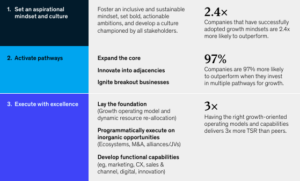
Set an aspirational mindset and culture
C-suite growth leaders share a common series of mindsets and behaviors from their communications to their willingness to learn through failure. Those who display at least three of the five key growth mindsets are 2.4 times more likely to profitably outgrow their peers (Exhibit 2).
The first part of the timeless holistic growth blueprint is to support aspirations with clear targets, milestones, and motivators—creating a North Star that feeds the broader strategic and cultural narrative of the business. Leaders are able to commit their company to action and maintain this focus in the face of timely jolts, inspiring an organization-wide culture that continually seeks out and pursues growth opportunities.
On the other hand, the leader who aspires to growth but underinvests in initiatives or removes funding from growth is one whose actions do not match their aspirations. C-suite leaders
who choose growth are much less likely to yield when challenges arise, finding opportunity in headwinds and reasons to innovate where others retreat to conventional defensive playbooks.
A further differentiator of growth leaders is their ability to build organizational buy-in, including from the board and investors. They tend to directly involve the board in their growth planning and they proactively communicate with investors⁵ using significant and credible targets to show how the growth plan will generate value. Growth leaders allocate the resources required to achieve goals and are more willing to change their operating model to enable growth, if that is what is needed.
Activate the growth pathways
When leaders choose growth and develop the right leadership mindsets and behaviors to support that choice, their natural position is 5
For more, see “Where companies with a long-term view outperform their peers,” McKinsey Global Institute, February 8, 2017.
Exhibit 2
Growth leaders set, communicate, and commit to growth consistently and with significant resourcing.
Mindsets growth leaders share
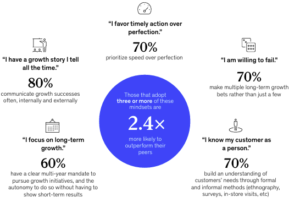
to look for opportunity wherever it exists. Those companies that set growth strategies to address all available pathways to growth are 97 percent more likely to achieve profitable above-peer growth.
The second part of the timeless holistic growth blueprint is activating three pathways: expanding the core business, innovating into new markets and adjacencies, and purposefully pursuing opportunities for breakthrough growth through new-business building or mergers and acquisitions (M&A).
The most successful companies are able to balance and sequence these growth choices in response to their changing operating environments, advances in technology, and emerging customer needs and preferences.
Expand the core business
Growth begins with the core, and growth leaders understand the importance of optimizing their current core business. With more than 80 percent of total revenue growth, on average, derived from the core, achieving excellence in current operations is crucial.⁶ Some sectors—healthcare, for example— achieve as much as 90 percent of growth from the core business, while others, such as financial services, generate around 74 percent from the core and 23 percent or more from adjacent opportunities (Exhibit 3).
These variations are partly explained by the idiosyncrasies of different industries. For example, healthcare businesses make long-term R&D and capital investments for innovation, but their patents enable them to generate most of their growth
⁶ Statistics in this section are based on McKinsey’s analysis of data from Corporate Performance Analytics by McKinsey, regulatory filings, and
S&P Global, for the period 2005–19; we have analyzed the 3,000 largest public companies as of 2018 reporting revenues by segment. Total
revenue growth split is derived from the summation of the respective company segment revenues in this sample.
Exhibit 3
Growth begins with the core, however, growth leaders expand beyond the core to drive growth.
Weighted average share of total revenue growth¹
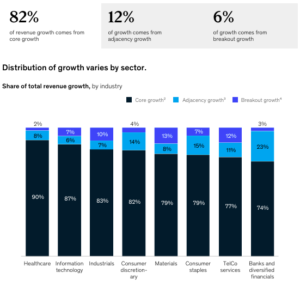
1Largest 3,000 publicly listed companies by revenue in 2018 with an average revenue of >1bn USD in 2005-09 and reliable business segment data, 2005–09 to 2015–19 (N=1,797).
2Core growth = Growth in industry with the largest share of revenue at the start of the analysis period.
3Adjacency growth = Growth in business segments that are within the sub-industries the company is already active in.
4Breakout growth = Growth into a new sub-industry.
Source McKinsey Corporate Performance Analytics, Capital IQ and strategy Analytics
within the core. Financial-services companies, on the other hand, tend to be more able to move into adjacent services, with many companies actively making big bets across industry sub-sectors (eg, investment banks entering wealth management,and vice versa).
Regardless of industry, growth leaders turbocharge their core through a mix of strategic shifts to higher growth pockets (for example, shifting product mix to higher growth value or premium segments and higher growth channels such as e-commerce), innovation of the core products and services, and improved executional excellence in their commercial capabilities.
Having a growth mindset is especially important for the core business. Growth outperformers almost always grow their core—either through their main products, sectors, or local market. In fact, it is unlikely that they can raise their growth trajectory without winning in their local market.⁷ In fact, fewer than one in five of the companies in our sample that had below-average growth rates in their local region managed to outperform their peers in growth.
Whatever the exact mix of strategies and focus areas, growth leaders are maximizing their core through all available means. And they are twice as likely to report having identified pockets of growth within their existing business.
Innovate into adjacencies
Having a strong core is essential. Outperformers build beyond it to achieve their growth aspirations. Businesses that expand into adjacent industries or segments are 20 percent more likely to achieve greater growth than their peers.
The obvious places to look for growth are new geographies and adjacent industries where growth leaders can adapt their existing offerings to serve new customer segments. For example, CVS Health transformed into a consumer-centric, integrated health solutions company by expanding its business from pharmacy and retail to healthcare services, which accounted for 67 percent of the company’s revenue growth from 2005–19.
Growth leaders recognize the need to unlock the next wave of growth through expansion beyond the core. However, choosing the best adjacencies is critical. Growth leaders are increasingly harnessing advanced analytics to identify promising or previously overlooked opportunities that leverage core competencies and provide a good chance to establish a strong leadership position. McKinsey research shows that businesses that expand to adjacencies with high similarity to their core and exploit their unique competitive advantages are more likely to profitably outperform their peers on growth.
Outperformers use the full growth blueprint to excel in adjacencies, with a particular focus on strategies that build on core competencies. They use and refresh growth maps to consistently surface opportunities, to understand which are most achievable, and set growth strategies to capture them. They choose among the different avenues to grow adjacently, such as M&A or business building, and they evolve their operating models to support these growth choices.
Growth leaders are also increasingly building ecosystems around their core capabilities and assets and deploying new offerings into adjacent products or markets. Tencent, for instance, has
become an Asian tech giant worth around $500 billion through its online platforms that include messaging, gaming, payments, e-commerce and advertising—in addition to evolving its social messaging app WeChat into an extensive “super app.” Tencent’s full ecosystem offering spans fintech, entertainment and media, cab hailing, location sharing, and more, fueling a revenue compound annual growth rate of 28 percent over the decade 2011 to 2021.
Ignite breakout businesses
According to McKinsey research on more than 1,000 business leaders, on average, executives believe 50 percent of their revenues will come from new products, services, or businesses within the next five years. Not surprisingly, many are looking beyond natural adjacencies to exploit entirely new business opportunities. Between 2018 and 2020, “new-business building” doubled its appearances among the top three items on executive agendas.
Expanding into new markets through business building can unlock new opportunities without cannibalizing existing products and services. Done right, the rewards can be well worth the risk, as illustrated by a number of growth leaders across different industries.
Amazon famously expanded beyond its e-commerce business into public cloud services through Amazon Web Services (AWS). By leveraging its core competencies of brand and
commercial strength, it built AWS into a business that generated $62 billion revenue.
⁷ Defined as the largest region in the portfolio by revenue.
Science and technology innovator Danaher Corporation combatted the single-digit growth in its core industrial businesses by looking toward high-growth markets in life sciences and niche
diagnostics. After testing the waters with small acquisitions and investing heavily in its platforms business, Danaher spun off its old industrial core, Fortive, repositioned life sciences and diagnostics as its new core business—and beat the S&P 500 by 3.8 times between 2002 and 2016. While core growth is critical, investments in breakout opportunities could enable a long-term shift to anew core within a higher-growth market.
Marcus by Goldman Sachs launched its first digital consumer business in 2016, allowing customers to bank from their phones. In the ensuing six years, it has attracted millions of customers, accumulated deposits of over $92 billion, and made more than $7 billion in loans via a combination of organic growth, acquisitions, and partnerships with Apple and
Amazon.
Growth leaders can improve their odds of achieving growth in breakout opportunities by committing to innovation, identifying and understanding the needs and wants of valued customers, and developing the right value propositions to appeal to them. Given the accelerating pace of innovation, growth leaders also look to agile methodologies, strategic alliances, and M&A, with a willingness to rapidly test and learn, fail and iterate, and invest in scaling opportunities.
Of course, pursuing breakout growth can require longer-term investment and commitment before seeing returns. That’s why growth leaders need the mettle to stay the course and make significant investments—or the sense to know when to call it quits.
Execute with excellence
This is the critical and third portion of the timeless holistic growth blueprint, where strategy meets action, and orchestrated execution is the final step in achieving growth. Execution works hand-in-hand with strategy to empower leaders to make the right choices at the right time to drive both short-term and long-term growth.
Leaders who choose growth support their ambitions by prioritizing a critical set of execution enablers: operating model and resource allocation, ecosystems, M&A, joint ventures and
alliances, and functional capabilities.
Built-for-growth operating models and resource allocation
Leaders who fully commit to growth choose these initiatives for purposeful and assertive investment and are 60 percent more likely to regularly reallocate resources from lower-return
to higher-return spaces. These leaders fund more dynamically, relying less on historical budgets that can be psychologically “anchoring,” and they actively explore how to fuel growth
without eroding their existing core businesses.⁸
Alongside this willingness to dynamically reallocate resources, growth leaders are more likely to have multiple, tailored operating models to support their unique growth initiatives and
opportunities. While the core business may have a distinct, more traditional operating model, breakout opportunities may adopt a more agile, learning-driven operating approach, for example, having small, cross-functional teams with the autonomy to focus on rapidly building and testing products, features, or services with customers. They segment their product-development processes and combine standard product development stage gates for incremental innovations while using venture-capital-inspired stage gates and funding mechanisms for bolder growth projects. This agility helps them respond robustly to timely jolts and opportunities.
In managing performance, growth leaders adopt a growth vocabulary, leveraging the adage, “You get what you measure.” They actively track leading and lagging growth-oriented metrics,
such as recurring revenue, revenue per customer, and customer-acquisition cost, tying them to organizational goals and incentives.
⁸ Tim Koller, Dan Lovallo, and Olivier Sibony, “Bias busters: Being objective about budgets,” McKinsey Quarterly, September 28, 2018; Michael
Birsham, Marja Engel, and Olivier Sibony, “Avoiding the quicksand: Ten techniques for more agile corporate resource allocation,” McKinsey
Quarterly, October 1, 2013.
Strengthen ecosystems, M&A, and joint ventures
Specialization in a sea of sameness is a differentiator. That’s why growth leaders often look outside of their businesses to find quick access to complementary skills and capabilities to buy or
scale innovation and growth. Those who do this are 30 to 50 percent more likely to continually scan forthese types of alliances, joint ventures, and M&A opportunities.
In recent years, digital M&A has become increasingly popular and effective, accounting for double the share of all M&A value from 2011–21. Businesses are becoming increasingly strategic
about how they evaluate and leverage these digital transactions, from acquiring new talent and capabilities to accessing new markets and products.9 Many companies with programmatic
M&A strategies (that is, steadily growing through two or more acquisitions of less than 30 percent of their own market cap per year) have added digital-investment themes to their M&A blueprints. Over almost 20 years of research, it has become clear that programmatic M&A is the only M&A strategy that delivers outsized total shareholder return (TSR). M&A investment themes, especially those on digital M&A, should be highly specific and clearly articulate how they will add value for the acquirer.
Forming ecosystems with partners is another way to build capabilities and expand offerings more quickly, while simultaneously enhancing customer experience and enlarging reach and innovation opportunities across the ecosystem. This creates value along two dimensions—it allows participants to consolidate a range of customers, often across sectors, and to play a pivotal role in optimizing touchpoints in both B2C and B2B. Execution is impossible without the right functional strengths and growth leaders identify which new functional capabilities are needed—or need to change—to support growth initiatives, both in the short term and over longer-term innovation horizons.
From building out AI and advanced analytics platforms to deepening their customer experience capabilities—and even enhancing or modernizing existing capabilities like pricing and marketing— growth leaders ensure the organization’s capabilities are positioned to fuel growth. While the exact blend varies by industry and company, a common cross-sectoral focus point is harnessing digital and analytics to revamp distribution, marketing returns, customer value management (CVM),¹0 and dynamic pricing.¹¹
In distribution, e-commerce is a powerful lever for collecting valuable digital customer data along the purchasing journey and ensuring effective and measurable media spend. Nike, for example, was able to increase its nike.com e-commerce platform’s contribution to sales from 7.5 percent to 24 percent, thereby fuelling a compound annual growth rate of 6.7 percent from 2017–21, a time frame that includes the height of the pandemic.¹²
For customer value management, investing in greater personalization through advanced analytics and digital capabilities can improve both the customer experience and client lifetime value. American Express, for instance, leverages advanced analytics to provide customized recommendations to customers based on their location, opening additional transaction opportunities both for their partners and for their own credit cards.
9 Michael Bogobowicz, Anika Pflanzer, Leandro Santon, and Brett Wilson, “How to find and maximize digital value in any M&A deal,” McKinsey,
November 9, 2020; CapitaIQ, McKinsey analysis.
¹0 Customer value management is a systematic approach to working with loyal customers. It is based on personalized offerings targeted
to meet particular customer needs, created using advanced analytics, and aimed at increasing lifetime customer value through raising purchasing
frequency and average basket size.
¹¹ Rachel Diebner, David Malfara, Kevin Neher, Mike Thompson, and Maxence Vancauwenberghe, “Prediction: The future of CX,” McKinsey
Quarterly, February 24, 2021; Ralph Breuer, Kedar Naik, Bogdan Toma, and Martina Yanni, “Executive quick take: A guide to implementing
marketing-and-sales transformations that unlock sustainable growth,” McKinsey, September 23, 2019; Matt Deimund, Michael Drory, Daniel
Law, and Maria Valdivieso, “The five things sales-growth winners do to invest in their people,” McKinsey, October 9, 2018; Minti Ray, Stefano
Redaelli, Sidney Santos, Jared Sclove, and Andrew Wong, “Accelerating revenue growth through tech-enabled commercial excellence,”
McKinsey, December 4, 2019.
¹² Statista, ecommerceDB, and S&P Capital IQ.
Greater analytical sophistication enables companies to differentiate pricing across dimensions such as region, channel, and customer lifecycle.¹³ A leading Asian e-commerce company
was able to increase gross margins by ten percentage points and gross merchandise value by three percentage points by developing a dynamic pricing capability.¹⁴
Commercial capabilities are bolstered by investments in digital—in fact, growth leaders are 60 percent more likely to have successfully used AI and advanced analytics to predict customer behaviors and become a “sensing and predicting” organization. Growth leaders also tend to invest in expanding and deepening their customer experience capabilities to streamline and
personalize customer journeys.
Beyond the commercial excellence, growth leaders map R&D and product development portfolios, balanced across incremental innovations and bolder long-term breakout initiatives with clear mapping to the capabilities needed to execute. Tangentially, it is imperative to ensure that growth leaders are investing in their people, creating a pipeline of talent that will help strengthen and broaden the tools needed to achieve their growth aspirations.
Choosing to grow: the subtle differencebetween success and failure
The growth blueprint defines the timeless elements on which leaders need to focus diligently once they’ve made a deliberate and purposeful choice to grow. This blueprint prepares an organization to grow in the face of timely jolts. The blueprint encourages leaders to answer a series of clear questions:
— Am I setting the right aspiration, mindset, and culture to encourage growth? Are my ambitions high enough, and how can I ensure my organization has the full potential to achieve it?
— Am I actively choosing growth opportunities across my core and adjacencies?
— Am I establishing the right enablers to execute against my growth aspirations and strategies?
— Do I have the right operating model and resource allocation to achieve my growth ambitions?
— And am I investing in the right functional capabilities?
The choices leaders make in response to these questions differentiate those who achieve growth from those who aspire to it but don’t get results.
Take two leaders of similar-sized businesses operating in the same market. Both see an opportunity for growth and pursue it, but their outcomes are very different. Why?
The one who made a choice to grow aligned their board and leadership team on the company’s direction and dedicated the necessary resources to growth. They adapted the operating model for the long term and understood the risk profile of the new businesses they were trying to build. They invested meaningfully in building the right functional capabilities, sometimes at the expense of a few quarters of earnings, to achieve their long-term growth aspirations.
The other leader, who didn’t explicitly “choose growth,” also did a lot of things right. They hired the right talent and took the time to understand the new businesses they wanted to build. They believed they were allocating enough resources to growth, but ultimately their focus was divided by an emphasis on quarterly earnings and short-term profitability. Though they aspired to growth, they didn’t have the long-term strategy or commitment to achieve it. They tried to protect the management team so they could meet their short-term goals but didn’t secure buy-in from the board for long-term growth initiatives.
Making the conscious choice to grow creates powerful momentum that orients the entire
¹³ Claus Heintzeler, Mathias Kullman, Karin Lauer, and Maximilian Totzauer, “Pricing and promotions: The analytics opportunity,” McKinsey, June
28, 2021.
¹⁴ Gadi BenMark, Sebastian Klapdor, Mathias Kullmann, and Ramji Sundararajan, “How retailers can drive profitable growth through dynamic
pricing,” McKinsey, March 27, 2017.
business toward that goal, from the C-suite to frontline employees. The growth blueprint defines the timeless elements on which leaders need to focus diligently once they have made a deliberate and purposeful choice to grow. It also prepares an organization to unlock growth opportunities in timely jolts. The clarity of purpose and vision that comes from choice is what helps leaders and their teams believe in the seemingly impossible and make it happen.
Michael Birshan is a senior partner in McKinsey’s London office, where Biljana Cvetanovski is a partner; Rebecca Doherty is a partner in the San Francisco office; Tjark Freundt is a senior partner in the Hamburg office; Andre Gaeta as an associate partner in the Sao Paulo office; Greg Kelly is a senior partner in the Atlanta office; Erik Roth is a senior partner in the Stamford office; Ishaan Seth and Jill Zucker are senior partners in the New York office.
The authors wish to thank Jaidit Brar, Luis Cerquiera, Vincent Cremers, Brian Gregg, Eric Hazan, Martin Hirt, Anna Koivuniemi, Pablo Leon, Duncan Miller, and Dennis Spillecke for their contributions to this article.
We are also grateful to the many McKinsey colleagues who contributed their industry expertise and perspectives to this research: Marco Aukofer, Matt Banholzer, Kurt Bazarewski, Dani Ebersole, Stephen Guerin, Tim Koller, Karin Löffler, Katherine Lovemore, Patrick McCurdy, Sakina Mehenni, Camille Meeùs, Bridget Morton, Michael Park, Tido Röder, Jeff Rudnicki, Manny Sasson, Balint Stellek, Marija Vukojevic, Qian Wan, and Michelle Wycoff.
